Santa Lucia in Selci is a 17th century convent church on mediaeval foundations at Via in Selci 82, in the rione Monti. Pictures of the church at Wikimedia Commons are here. An English Wikipedia page is here.
The saint[]
The dedication of the church is to St Lucy of Syracuse, a 4th century virgin and martyr who has her feast-day on 13 December. (The full dedication includes Our Lady, under the aspect of her Annunciation.)
However, there has been confusion in the past about which Lucy is concerned. The titular saint used to be celebrated on 16 September, and was identified with a widow martyr of Rome called Lucy. She was venerated on the latter date as one of two martyrs, Lucy and Geminian, who have a fictitious legend. The scholarly consensus is that this Lucy is a reduplication of the one from Syracuse and so she and her companion have been deleted from the revised Roman Martyrology.
History[]
Ancient times[]
The Via in Selci is now a quiet and picturesque side street, but it is actually one of the few streets in the present city which has been in continual use since ancient times. It was the ancient Clivus Suburanus, the main traffic artery from the Forum to the Porta Esquilina in the Servian Walls and from there dividing as the Via Tiburtina and the Via Praenestina. On it stood the Porticus of Livia, which was a massive public building in the form of a large rectangular piazza surrounded by a double colonnade or porticus measuring 120 by 95 metres. It is shown on a surviving fragment of the Severan Marble Plan and so we know where it was located, but archaeologists have found no trace. However, the convent seems to occupy the footprint of the north-east corner of its layout.
If you look at the convent's street frontage to the east of the entrance, you will see some ancient remains incorporated into it which are tentatively regarded as having belonged to an insula (ancient apartment building) or basilica (meeting-hall) standing on the next city block to the east of the Porticus. There has been some debate about the original identity of this building. One suggestion is that it was one of the two tituli associated with the early history of San Martino ai Monti nearby and so built in the 5th century, and another that it was a public basilica (that is, a meeting place not a church) built in around AD 300 and converted into the original church of Santa Lucia in the 7th century (see below). The evidence is insufficient to support or deny either of these hypotheses.
Foundation[]
There is a tradition claiming that the first church here was built under Pope Symmachus (498-514), but this is not properly documented and seems to relate to the confused sources concerning the early history of San Martino ai Monti and the two tituli associated with it (see that church's page for a summary).
According to the Liber Pontificalis, Santa Lucia was actually founded as a diaconia or centre for Church charitable activities by Pope Honorius I (625-638). The entry reads: Hic fecit ecclesiam beatae Luciae in urbe Roma iuxta S. Silvestrum, quam dedicavit et multa dona obtulit ("He made the church of blessed Lucy in the city of Rome near that of St Sylvester, which he dedicated and to which he offered many gifts"). That such an institution was founded here in the 7th century indicates that there was still an appreciable population in the neighbourhood. This was soon to change, as the city's ordinary inhabitants abandoned the hills for the valleys in order to have easy access to water after the aqueducts had collapsed.
St Sylvester's church referred to is now San Martino ai Monti.
Monks[]
The diaconia might have been staffed by monks from the time of its foundation by Pope Honorius. in 614 the Sassanid Persians conquered the Holy Land and massacred many Christians, including monastic communities. Other monks became refugees, and some ended up at Rome. This was the beginning of a strong Eastern-rite monastic presence in the city, which was augmented by further refugees from the conquests of Islam and the iconoclast policies of the Byzantine Empire. The monasteries that these exiles founded in the city had a period of glory in the 7th and 8th centuries, when Greek-speaking Byzantine-rite clergy were very influential in Rome and even provided popes.
A major restoration by Pope Leo III (795-816) is on record, and another one by Pope Gregory IV (827-44). The name of the church back then was Santa Lucia in Orfea, which seems to derive from a local ancient fountain called Lacus Orphei which itself might have featured a statue of the god Orpheus. The location of this fountain is unknown, but the neighbourhood had the name Orfea in the Middle Ages. By then, it was right on the edge of the built-up area -urban settlement stopped at the Suburra to the west.
The monastery here would have taken over by Benedictines in the 10th century, but (as usual) the process is undocumented. This is because the Benedictines wished to preserve the fiction that they had been in Rome since the late 6th century, and the dominant presence of Eastern-rite monastics at Rome was maliciously airbrushed from the historical awareness in later mediaeval times.
In the early 13th century the monastery was completely rebuilt, including the church. It is thought by some that the old church was not on the present site, but might have been further to the west. Alternatively, the ancient remains visible in the convent frontage to the east of the entrance have been claimed as part of the old church.
This new complex was initially for the Benedictine community, but the convent was granted to the Carthusians later that century after Benedictine observance collapsed in the city. The Carthusians were there until 1370, when they moved to Santa Croce in Gerusalemme. (Beware of confusion in modern sources; they left in that year, rather than arrived.) A small caretaker community might have remained for the next twenty years or so, as the Carthusians remained as owners of the property. However, in the 15th century the convent seems to have been abandoned and was presumably used as a farmstead.
Nuns[]
In 1534 part of the property, including the monastery and church, was given to Benedictine nuns who had begun life as an informal sisterhood (bizzocche) associated with the convent at Santa Maria della Concezione in Campo Marzio. The new community did not persevere, and in 1568 Pope Pius V granted the convent to a group of Augustinian nuns. Their descendants still live here, but they seem to have struggled initially.
In 1577, the ancient diaconal cardinalate fell vacant. It was then suppressed in 1587 by Pope Sixtus V, and the title transferred to Santi Vito e Modesto -allegedly because the original church was ruinous and disused. In 1588 the western portion of the extensive convent grounds was sold by the Carthusians to enable the foundation of Santa Maria della Purificazione ai Monti, a new Poor Clare nunnery. The two nunneries were to be neighbours for almost four hundred years, with their properties separated by a garden wall.
The church was reconstructed by Carlo Maderno beginning in 1604, as part of a project to improve the monastery buildings (Bartolomeo Bassi had actually started this in the previous year). He had been appointed by the nuns in 1596, after financial patronage by family members of some of the nuns had improved the community's prospects a little (this patronage is witnessed to by the side chapels in the church). Formal consecration was in 1619, but Maderno continued intermittently to supervise work on decorative elements in the church as well as on the convent buildings until his death in 1629. Then Antonio Casóni took over and concentrated on finishing off the convent buildings, until he died himself in 1634.
The church was embellished between 1638 and 1643 by Francesco Borromini, when he was employed as the convent architect. The surviving Landi Chapel is by him, as was the main altar until its mutilation in a 19th century restoration which saw a major re-ordering of the sanctuary.
Modern times[]
The convent survived until 1873, when together with almost all others in Rome it was sequestered by the Italian government. For most nuns in Rome this meant leaving home and surviving in various temporary lodgings until finding a new (often purpose-built) residence. This could mean real suffering. Papal enclosure meant that nuns were not allowed outside the convent limits, but the old convents all had gardens -some of them extensive. After 1873, some communities had very limited access to open air.
Here, however, although the State kept the freehold the Augustinian nuns were able to obtain a tenancy. They were, however, joined by two refugee communities. The Poor Clares from the convent of San Lorenzo in Panisperna came here in 1878, and also a community of Dominican nuns from Santa Maria Annunziata ai Monti in the Roman Forum. A visitation in 1904 revealed that having three separate communities in one convent (albeit a large one) was not working very well.
The three communities are still resident. The Poor Clares are in the west end of the range of the street, at number 82/A. The Dominican nuns lost their convent to "archaeological" demolitions and so are still here also. They occupy the eastern end of the convent buildings, with their own entrance at Piazza San Martino ai Monti 142.
The original community belongs to the Federation of Augustinian Nuns of Our Lady of Good Counsel, as does that at the nearby convent at Santi Quattro Coronati. The principle of enclosure is still maintained, and their public profile is very low-key (they have no Internet presence).
Unfortunately, the latest (2015) information from the Diocese is that there are only three nuns listed as permanently resident in Rome in the two convents, after one died recently.
The chaplain for this church is listed as a Redemptorist priest, P. Andrea Sampers CSSR.
Lipsanotheca[]
The Augustinian sisters have a very interesting work. Since the 1920's, they have been in charge of the Lipsanontheca or official relic depository of the Diocese of Rome. This is a collection of relics of saints, which are supplied to Catholic churches and religious institutions worldwide for use in liturgical functions (all consecrated altars, for example, should contain such a relic). There are relics of over two thousand saints and beati here, going back to early times (although only those with proper documentation are now available). The sisters are also responsible for the collection and preparation of relics of those newly canonised or beatified, and presenting them for distribution by the postulators of the causes. These items fall into two categories: thecae or actual small relic-boxes, and prayer-cards with a little snip of cloth that had touched a relic.
This work has been the main source of income for the sisters in recent times, although the income is from the preparatory work. No relic is ever sold. Unfortunately, there was a scandal in 2003 when a private person obtained a relic of the Column of the Flagellation and then wrote about it in a book, giving the impression that he had bought it. This led to the sisters being rebuked, and the process of obtaining a relic being seriously tightened up. The word now is that no private person has a hope of obtaining a relic without the written support of his bishop.
The sister now in charge is Sr Adriana Carnevale OSA.
Exterior[]
Layout[]
The convent is not arranged around a cloister, but is based on a long block running along the street. The church is on the ground floor of this, and has no independent architectural identity or any external sign of its existence. The fact that its major axis is parallel with the street means that there has never been a façade.
There is a second wing at the back, at right angles to the first one and running south. It has been surmised that this wing, and the main wing to the west of it, are actually on the footprint of the north-eastern corner of the ancient Porticus Livia. There seems to be no archaeological evidence for this, but the location corresponds to that given for the porticus on the Severan Marble Plan.
At the eastern end of the complex, facing onto the Piazza San Martino ai Monti, is an adjacent but separately built block rendered in pink which is now the Dominican convent.
Street frontage[]
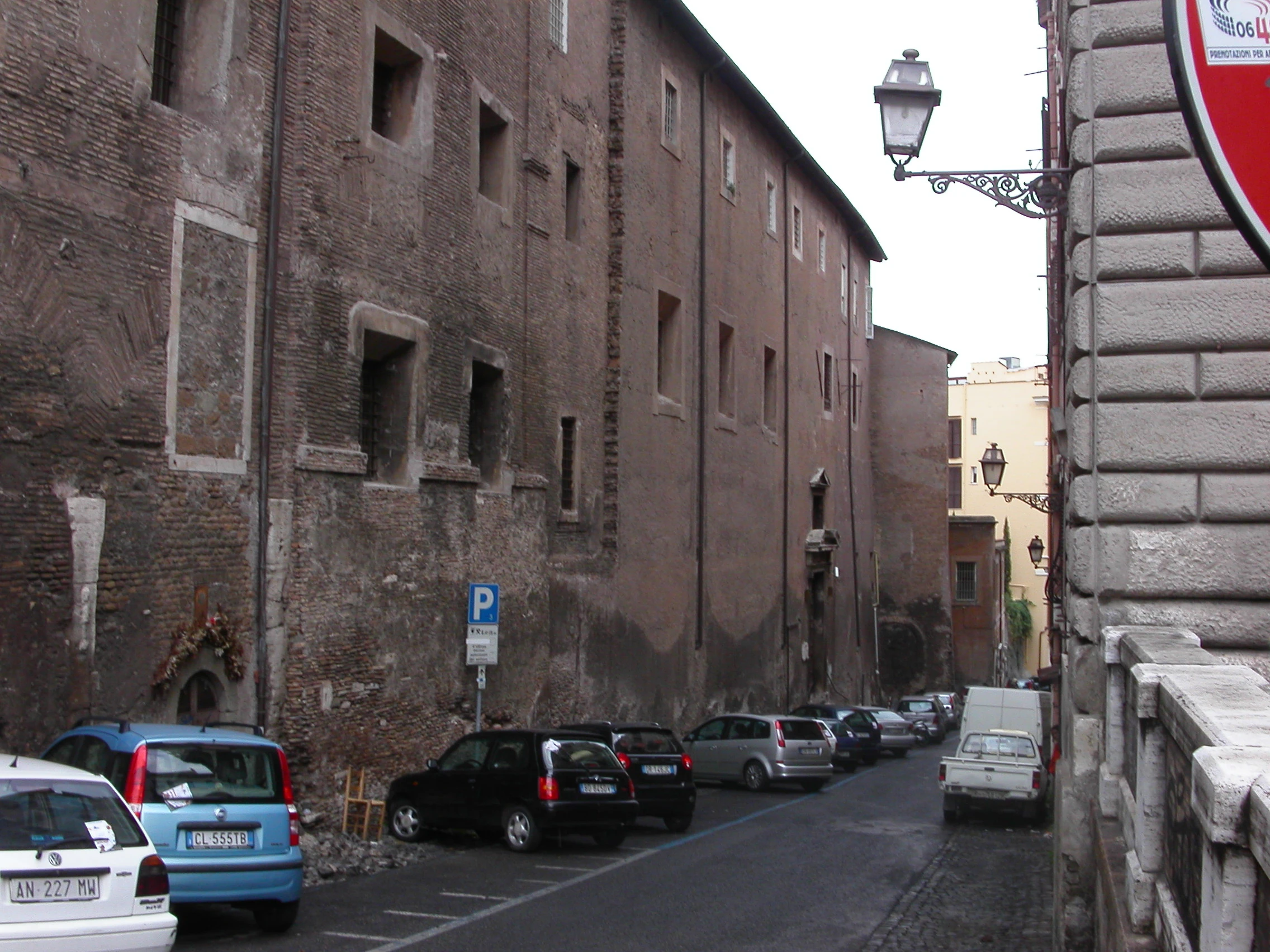
The rather grim and unadorned street frontage is in red brick, with windows recessed within rectangular stone frames. It dominates the narrow street without any attempt at a civic presence, and so gives a mediaeval impression.
The very interesting ancient remains are towards the east end of the frontage, near the Piazza San Martino ai Monti. Here the brick façade of an ancient building has been preserved up to the second storey. The favoured interpretations of its original function are that it was an insula, or a public basilica. The latter interpretation rests on some similarity to the so-called "Library of Agapetus" on the Caelian (near San Gregorio Magno al Celio).
There were originally five rectangular openings in the first storey, presumably leading into shops. These were separated by travertine limestone pillars, four of which survive embedded in the present wall, which supported horizontal lintels which are gone. However, you can see the difference between the finely laid brickwork above the former lintels, and the rough blocking using scavenged materials below. Allegedly a Priapus is carved on one of the pillars, but it is not obvious. A set of five brick relieving arches are in the wall above the pilasters, and above these were five large round-headed windows. These have been blocked and replaced by smaller rectangular ones. It is this feature that supports the basilica interpretation, as they seem intended to light a large second-storey aula.
The suggestion that this building ended up as the original church of the diaconia is a guess.
Down the slope of the street, the unassuming Baroque entrance (thought to be by Bartolomeo Bassi) is accessed by a short flight of stairs. The molded doorcase is flanked by a pair of thin pilasters strips ending in pendant posts which support a broken segmental pediment missing most of its arc. Into the tympanum is inserted a square window, which has its own little triangular pediment. There is no proper entablature, but a frieze between the doorcase lintel and the pediment bears the name of the convent.
This entrance replaced a smaller one that opened directly into the church, the blocked-up outline of which can be seen to the left.
The entrance to the Poor Clare convent is a simple doorway further down the slope.
Vestibule[]
Beyond the door is the entrance vestibule of the convent. The door to the church is on the left, and that to the monastery parlour is to the right.

The church entrance has a stone doorcase, over which is the dedication: Sanctum Deo Deipare et S[anctae] Luciae V[irgini] M[artiri] ("Holy to God, the Mother of God and St Lucy, Virgin Martyr"). This is topped by a double pediment supported on little volute corbels, which has a segmental pediment inserted into a larger broken triangular one.
In the parlour entrance wall is an aperture with a molded marble frame and a little shelf. Over it is the name of the convent in Italian, topped by the symbol of the Sacred Heart within a little tondo embellished with curlicues. The aperture contains a circular wooden cupboard with drawers, known technically in English as a turn. The idea of this device is that smaller items can be delivered to it by, for example, a shopkeeper, which a nun could then collect without the two having to set eyes on each other. The suggestion published online that this device was for abandoned newborn children being given to the nuns is false, although there were communities of sisters in the city who took care of foundlings.
The parlour entrance is unadorned.
Interior[]
Layout[]
The church has a single nave of three bays without aisles, and a narrower rectangular apse as a sanctuary. The nave walls each have three widely separated arched recesses, and the further two on each side have been fitted out as chapels.
[]
Overall the interior decoration is in white, with much gilded stucco detailing. The arches of the side arcades are in between four ribbed Doric pilasters with gilded ribs, which support an entablature running round the interior. The architrave and cornice of this entablature are both richly decorated with several rows of gilded decoration, but the frieze is in blank white. Another pair of these pilasters support the triumphal arch, and a matching pair flanks the entrance. The arcade archivolts spring from solid Doric impost piers, which are embellished as part of the decorations of the chapels that they flank.
The ceiling is barrel-vaulted. It has three window lunettes on each side, and two wide transverse rib-arches separating the bays. These are embellished with gilded scrollwork in grotesque style, and the same style is used in much of the church's decoration elsewhere. The triangular coffers contain stucco wreaths with ribbons, and the central octagonal panels in the near and far bays have more scrollwork. However, the central bay's tondo has an anonymous 19th century fresco depicting the Glory of St Lucy, which replaced one by Giovanni Antonio Lelli.
On the counterfaçade above the entrance is a cantorie or balcony for solo musicians, designed by Borromini. It now contains the organ. The gilded scrollwork on it matches that of the ceiling, and Borromini's involvement can be discerned in the corbels each of which is formed from three ribbed and incurved straps brought together. Under the balcony is a quatrefoil ovoid tondo containing a fresco of God the Father by the Cavaliere d'Arpino, which is surrounded by a gilded garland. This garland is continued as drooping swags on either side, and above the tondo is an engaging little angel blowing a trumpet with three bells.
The first facing pair of side arches are not chapels, but contain tablets bearing historical details about the church. In the tympani of these two arches are two very winsome (or repulsive, according to taste) putti which are frescoes obviously of the 19th century.
The third bay of the nave is now screened off as the nuns' choir, by a low and very low-key iron railing which does not interfere with the view of the sanctuary.
Sanctuary[]
The triumphal arch has a molded archivolt, and above five panels fitted into the curve between it and the ceiling vault. These are decorated with more grotesque tendril decoration. The sanctuary itself is a narrow rectangle, lit by a round-headed window on the left hand side which is matched by a false one on the right. Here also there are doors to the small sacristies.
The altar is a pedestrian 19th century neo-Classical design, which replaced one by Borromini. Two alabaster Ionic columns on very high plinths support a low triangular pediment on a deep entablature which has a molded architrave. The altarpiece is The Annunciation by Anastasio Fontebuoni. In between the plinths of the columns, and below the altarpiece, is an aperture which once allowed the nuns to receive Communion. It is protected by a survival from the original Borromini altar, a gilded bronze grille which was made by Giulio Cianchi to his design. It has a conventional grid of squares over a capsule-shaped portion filled with curlicues. The white marble frame of the aperture is mediaeval, and is thought to come from a shrine. The mensa and frontal of the Borromini altar were re-used. Nowadays there is a statue of St Lucy on the altar, rather obscuring the view of the grille.
The altar pro populo, erected for the saying of Mass facing the people, is in front of the high altar. It has a frontal in relief depicting The Last Supper in beaten copper, which is actually quite impressive. However, the artist's attempt to portray St John as resting on the breast of Christ has not worked -the evengelist looks as if he has passed out drunk on the table!
Flanking the high altar is a pair of doors leading into the old choir, over which are two panels with more grotesque decoration.
Chapel of St Lucy[]
Since the main altar is dedicated to Our Lady, St Lucy has her own chapel. This is the first one the right. The altarpiece is The Martyrdom of St Lucy by Giovanni Lanfranco, which fills the entire arch over the altar. In it, the saint is shown pointing up to the heavenly light (her name derives from lux, the Latin for "light"). The intrados of the arch is coffered with rosettes, and in the spandrels are two angels holding the symbols of martyrdom -a crown and a palm. In between is a Baroque tablet bearing a little laudatory epigraph -Columna es immobilis Lucia, sponsa Christi ("You are an unmoveable column, Lucy bride of Christ"). There are climbing roses on the impost piers.
This is the Cappella Vanini, sponsored in the 1630's by the family of two blood sisters in the community called Caterina and Virginia Raimunda Vanini. The family shield is below the tablet on the keystone.
Chapel of St Augustine[]
The second chapel on the right is dedicated to St Augustine of Hippo, and the altarpiece depicting The Vision of St Augustine is by Andrea Camassei. There are two allegorical figures sitting in the spandrels of the arch, the intrados of which is embellished with vine-scrolls. The impost piers are richly decorated with gilded panels showing more allegorical virtues.
This is the Cappella Cerri and was paid for by Antonio Cerri whose two daughters, Maria Antonia and Maria Celeste, were daughters here. The family shield is on the keystone.
Blessed Sacrament Chapel[]
The Chapel of the Blessed Sacrament is the second on the left, and was patronised by a nun called Isabella Melchiori. Her family's shield in on the keystone of the arch. The altarpiece by Camassei has an unusual subject: Our Lady Receiving Holy Communion from St John the Evangelist. The impost piers have gilded stucco reliefs of angels holding the Instruments of the Passion.
The extremely impressive tabernacle is in the form of a miniature Baroque church frontal, in polychrome marble, albaster and gilt bronze. It is attributed to Carlo Maderno, and has four little gilded bronze statues of saints in niches and four white marble statues on its parapet. There are six miniature Composite columns, four in green marble and two in pink, and in the second storey is a picture of the Madonna and Child.
The gilded statues are of SS Elizabeth of Hungary, Augustine, Lucy and Monica (Augustine's mother).
Chapel of the Trinity[]
The Cappella Landi is the first chapel on the left. It was paid for by the prioress Clarice Vittoria Landi, and was designed by Borromini. The stucco work is more impressive than that of the other chapels, and the allegorical figures in the arch spandrels have gilded dresses. A pair of ribbed Composite columns with incurved capital volutes frame the altarpiece, and these support a pair of kneeling putti venerating the altarpiece. A smaller pair of putti below the keystone of the archivolt hold a ribbon with the tag Unum sunt ("They are one"). A gilded relief of God the Creator is on a Baroque plaque on the keystone.
The altarpiece is The Holy Trinity Venerated by SS Augustine and Monica, by the Cavaliere d'Arpino.
Choir[]
The monastic choir is inaccessible to visitors. It is described as containing several paintings by Baccio Ciarpi: St Charles Borromeo, St Ambrose, St Lucy and The Adoration of the Shepherds.
Access and Liturgy[]
When this Wiki page was first written, it read:
"The church is usually closed on weekdays. After ascending the steps leading to the door, you will find the church entrance on the left and the convent gate on the right. If the church is closed, ring the bell by the convent gate (within reasonable hours), and ask to be let in. Many of the sisters are from the Philippines, so you should be able to find someone who speaks English. There is no entrance fee, but a donation should be given."
Most such casual arrangements for visiting otherwise locked churches in Rome are now defunct, owing to the decline in the number of clergy and religious as well as worries about insurance. It is now a kindness NOT to ring the bell if the main entrance door of the convent is found closed, as the remaining nuns will have little time to spare from their routine duties to attend to you.
An unofficial source (tourist website 060608 in 2009) states that Mass on Sunday is celebrated publicly at 9:30, and that the church is opened between then and 10:30 for this.
The feast of St Lucy is celebrated with great solemnity on 13 December, as is that of St Augustine of Hippo on 28 August. These are equivalent to Sunday.