Santi Luca e Martina is a 17th century confraternity church located by the Roman Forum at Via della Curia 2 in the rione Monti. It is a familiar landmark on the Via dei Fori Imperiali. Pictures of the church at Wikimedia Commons are here. There is an English Wikipedia page here.
The unique dedication is jointly to St Luke the Evangelist and to St Martina, a 3rd century Roman virgin martyr (allegedly).
History[]
Ancient times[]
The location here used to be the Comitium, the political centre of the ancient city from the earliest times and functioning as such since at least the 7th century BC. It started as an open-air meeting-place, and might well have been the original neutral location for debate between the Bronze age villages on the surrounding hills in the second millennium BC. This was when Rome was nothing more than a scatter of such villages and a trading area besides the lowest fording point on the Tiber, where the Bocca della Verità now is.
The actual site of the church was occupied by the Curia Hostilia, the first senate house of the city which is thought to have originally been a large hut which combined the functions of a temple (the sacredness of which would have enforced non-violent behaviour) and a debating-hall for the village delegates. This evolved into a dedicated aula for the archaic city's alpha males, and as such survived until 52 BC when a badly-managed funeral pyre burned it out.
This was then replaced by the so-called Curia Cornelia, a much bigger building. It lasted barely a decade before Julius Caesar demolished it, and built the Curia Iulia or Senate House next door. Part of the site was then occupied by his Forum Iulium, the line of the temenos wall of which passes under the church. The remaining part of the site next to the Comitium was occupied by the new Temple of Felicitas, which did not survive the first century AD.
After that, the site was occupied by nothing more than a row of shops or tabernae attached to the Forum Iulium until the Curia was rebuilt by the emperor Diocletian. The Secretarium Senatus, which was primarily a private court for the investigation of the activities of senators, then occupied one of these premises.
An inscription records that the Secretarium was rebuilt by Nicomachus Flavianus the Younger at the start of the 5th century, and restored by Annius Eucharius Epiphanius in the year 414. The Senate House was still a fully functioning institution, and was to remain so for another two centuries.
Santa Martina[]
The original church on the site was dedicated to St Martina, who unfortunately has fallen into some neglect despite once being regarded as an important patron of the city. Her surviving legend first appears in the 8th century, and unfortunately is completely fictional. It derives from the Greek acta of St Tatiana, and the emperor and consul mentioned never existed. However, the old church contained an undated and now lost epigraph reading: "Here lie the bodies of the holy martyrs, the virgin Martina and her companions Concordius and Epiphanius". The revised Roman martyrology merely notes her association with the church, without giving any details about her or her putative martyrdom.
There is evidence of an early oratory dedicated to her at the tenth milestone on the Via Ostiense, and a suggesion is that she was martyred there.
Foundation[]
The church here dedicated to St Martina was founded in the 7th century, but the actual circumstances are unknown. It is often asserted that the Secretarium was converted into a church in the same project by Pope Honorius I that saw the Senate House converted into the church of Sant'Adriano, but this is a surmise. What is known is that the church used to have a mosaic showing St Martina flanked by Pope Honorius and Pope Donus, and the revised Roman martyrology now states that the church was founded by the latter pope in 677. This is forty-seven years after the consecration of Sant'Adriano.
The first documentary reference is in the Liber Pontificalis for Pope Adrian I (772-95), and in the entry for Pope Leo III is referred to as S. Martinae in tribus fatis. It was later known as "the church in three forums" (tribus foris), allegedly as it stood where the Roman Forum meets those of Augustus and Caesar. However, the original name seems to refer to three female pagan statues.
Middle ages[]
The original church had a single nave, with an apse. It was not large. However, it and the neighbouring church of Sant'Adriano had some importance in the Middle Ages and there is evidence that the two buildings continued to be used for civic functions until the 12th century. Also, the tradition grew up of starting the papal celebration of the feast of the Presentation of the Lord with the pope blessing the candles at this church, before going in procession to Santa Maria Maggiore.
In 1256 the church was rebuilt and re-dedicated by Pope Alexander IV.
A surviving engraving of 1575 is here. It shows Sant'Adriano to the right, and Santa Martina hiding behind a domestic building to the left. The ridge of the roof and the little bellcote can be seen.
San Luca[]
The presence of St Luke in the dedication has its remote justification in the existence of a small church called San Luca near Santa Maria Maggiore.
This used to stand on the north corner of the Piazza dell'Esquilino, with its left hand side wall along the Via Urbana. This piazza has had its sides shaved off by building development on the other side of the Via Cavour from the basilica. To locate the site, draw a line on a map which extends the line of the present Via dell'Esquilino north-westwards until it intersects the stub-end of the Via Urbana (blocked by the elevated Via Torino). The church stood on the north-east corner of this point of intersection.
It first appears in the late mediaeval catalogues, and in 1371 was put in the care of the Chapter of Santa Maria Maggiore. It is fairly certain that it was a descendent of a monastery perhaps founded here in the 8th century, but trying to figure out which of the monasteries in the documentation this might have been is pure guesswork.
The church was parochial, with burial rights.
Pope Sixtus IV (1471-84) donated the church to the guild of painters (Compagna dei Pittori), which had been founded in 1477 and was to be here for over a hundred years. Then in 1588 Pope Sixtus V sequestered the building, and had it demolished in order to improve the ambience of the piazza. In compensation, the painters were given the old church of Santa Martina.
Engravings featuring San Luca are here.
Initial works[]
Part of the deal was that the dedication of the lost church was to be preserved, since it was the only one in the city dedicated to the evangelist. Hence, the old church became Santi Luca e Martina in 1589.
The painters were not happy with the deal, but did not have the money initially to do much more than revamp their new property. Lack of funds stymied a rebuilding proposal by Giovanni Battista Montano in 1592 which was rivalled by one from Ottaviano Nonni, Il Mascarino, and also plans by Federico Zuccari in the following year. Montano was lecturing on architecture at the Compagnia at the time, and they kept the wooden model of his proposal.
The confraternity had brought their burial rights with them, and so began by digging out a crypt and installing a new church floor at a higher level. This helped with a long-term problem of flooding, since the old floor was below ground level. The crypt was to be a place for burials. Then they rebuilt the priest's house with two storeys in front of the façade to provide accommodation for their activities (done by 1595), and finally heightened the walls of the church and put on a new roof without a ceiling. The project was finished in 1618. Giovanni Baglione published another rebuilding proposal in that year.
Meanwhile, the Compagnia had become the Accademia di San Luca in 1593.
Reconstruction projects[]
The job was not well done, and a surviving visitation description of 1625 indicates that the church was decaying. The roof was leaking, and apparently the interior walls were left unplastered and the windows unframed. This was embarrassing for an institution that had been founded for those who were "artists, not just craftsmen", because they were vulnerable to the riposte "not craftsmen".
Matters took a turn for the better in 1626 when Cardinal Francesco Barberini, nephew of Pope Urban VIII, became the Cardinal Protector of the Accademia. He sponsored the appointment of Pietro da Cortona as its principe (head), who was allowed to begin the remodelling of the crypt in order to provide a tomb for himself. This was in 1634. Very fortunately, the alleged relics of SS Martina, Concordius and Epiphanius were immediately discovered in the crypt and so the cardinal promised to finance a completely new church with Pietro as architect.
Rebuilding[]
Work began in 1635, and proceeded rapidly until 1639. By then, the lower storey of the façade and the entrance bay of the church were completed, and the "lower church" (the amplified crypt) was well underway. Unfortunately, in 1640 the cardinal was accused of embezzlement by Pope Innocent X and so fled to Paris. Pietro da Cortona occupied himself with commissions in Florence, and work stopped completely for seven years.
Operations only re-commenced when both cardinal and architect returned to Rome in 1648, but this time the project was under the direct authority of Gian Battista Soria who was the new principe. Pietro da Cortona was given a supervisory role, but there is evidence that the original plans were changed especially as regards the "lower church". The fabric of the main church took ten years to finish, and the dome was constructed in the 1660's. When Pietro died in 1669, the edifice was substantially complete. The provision of decorative elements for both interior and exterior went on until 1679 under Ciro Ferri.
Pietro's design for the façade was never completed. He had planned suites of ancillary rooms in the inner angles of the church's cross-plan on each side, giving two subsidiary frontages which would have been slightly on the diagonal. The intended appearance is reproduced in an engraving here.
Embellishments[]
The right hand side altar was installed by Lazzaro Baldi in 1682. Carlo Fontana was commissioned to lay the polychrome marble floor in the lower church in 1694, but his proposal for the left hand side altar was not followed through. This altar was for a long time left unfinished.
The dome was struck by lightning in 1706, which cracked it and let the water in. Carlo Buratti was commissioned to put matters right in 1719, but apparently exceeded his brief as the Accademia complained that he had altered parts of the interior design without their approval. He began work on the left hand altar in 1722, but this was finished by Sebastiano Conca only in 1740. To Buratti also belong the interior doorways, the cantorie and the sanctuary balustrade, work on which was also completed in 1740. The stucco reliefs on the dome pendentives had been finished in 1730.
There has been very little alteration to the interior since 1740.
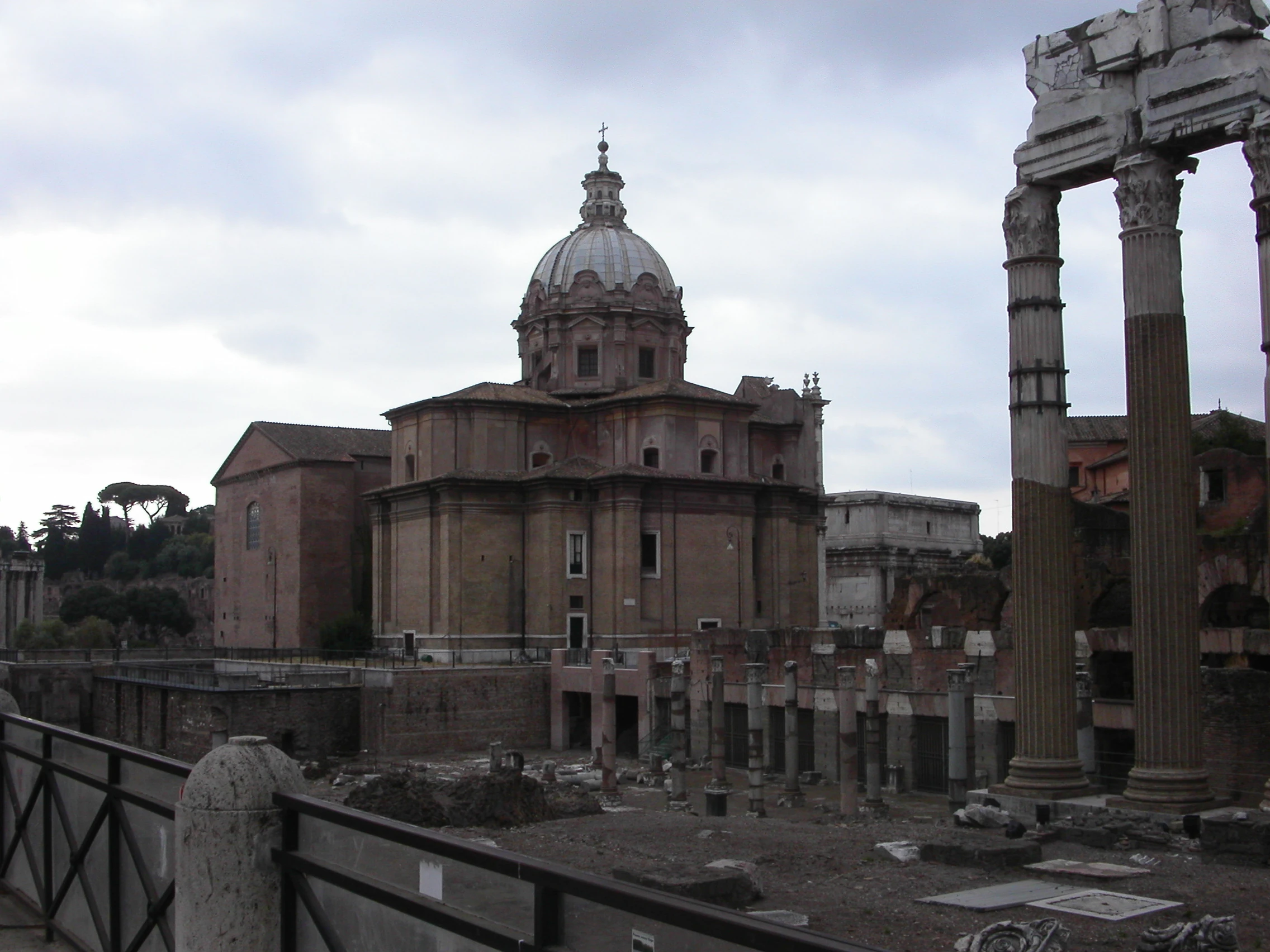

The Senate House (former church of Sant'Adriano) is on the left.
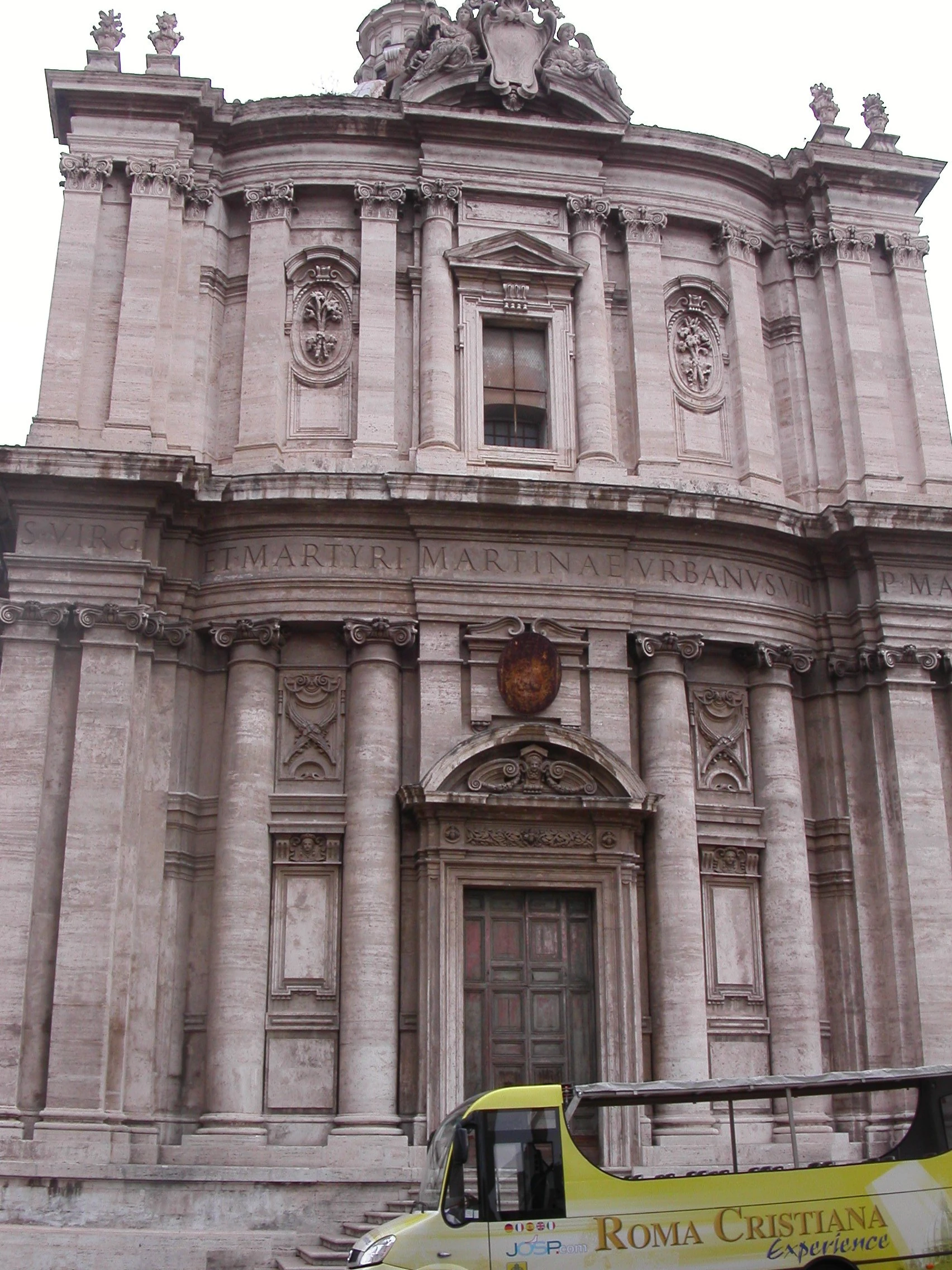

Modern times[]
The surroundings of the church began a radical change in 1802, when the French occupiers of the city commenced excavations of the Forum. These were continued through the 19th century, the initial intention being to free the Arch of Septimius Severus from accumulated debris. The lowering of the ground level necessitated the provision of a new set of entrance stairs.
The church's neighbouring buildings, including the headquarters of the Accademia, were demolished by the Fascist government in 1932. The academy moved to the Palazzo Carpegna, which stands on what is now the Piazza dell'Accademia di San Luca near the Trevi Fountain. The church was left as an isolated structure surrounded by fragmentary ancient ruins, and with only the gutted and rebuilt Senate House (the former church of Sant'Adriano) for company.
The next few decades were problematic. By the mid 20th century the church was rarely to be found open, and was falling into decay. The dome caused especial concern, and the city executed repair work in 1985. However, a complete restoration was needed. The crypt was restored in the three years after 1996, and the main interior by 2008.
The Accademia remains in possession.
Exterior[]
Layout and fabric[]
The plan of the church is reproduced here. It has the form of a not-quite Greek cross, with a central dome over a crossing with four arms. The entrance and sanctuary arms both comprise one bay with a semi-circular apse, and are of equal length. The side arms have narrower bays and innovative shallowly curved apses, and are shorter.
There are two sacristies in the far inner corners of the cross, and two custodian's chambers in the near inner corners. The fabric of the latter is fronted by the façade, which conceals the existence of the entrance apse.
The façade is in travertine limestone, but the main body of the edifice is in brick. Nowadays the side walls are exposed and look very grim, but before the 20th century were completely concealed by adjacent buildings and so were not meant to be seen. A street called the Strada Bonelli separated this church from Sant'Adriano (the present Senate House), and the right cross-arm had a subsidiary façade on it. There was even a small domestic building butted onto the right hand side of the main façade at the street junction.
The roofs are pitched and tiled, and hipped in sectors at the apse ends.
There seems never to have been a campanile, which is unusual in a Roman church.
Dome[]
Pietro da Cortona took great care over the external appearance of the dome. The design could be accused of being fiddly, but it works.
The tall drum is in travertine, and is separated into eight sectors by non-Classical pilasters with sloping plinths and with each having a recessed panel with a stepped edge. In place of capitals there are blocks bearing triglyphs, which support the posts in a cog-wheel entablature. Each sector contains a large rectangular window within a molded frame and having a raised triangular pediment which intrudes into the entablature and touches the cornice. In between the window and the pediment is a panel with a Barberini bee (from the family crest of Pope Urban VIII).
The dome itself is hemispherical, in lead with prominent ribs which spring from inverted posts on the entablature cornice. In between each pair of posts is a stone lunette, containing a semi-circular panel with a molded frame and with a double curlicue on top (like the letter C with its open end facing down). This curlicue device has been noted as echoing the shape of the side apses in the church.
The complex lantern has two storeys. The lower has eight rectangular windows separated by free volute corbels, and the upper has eight round-headed windows separated by little Ionic pilasters supporting a crowning entablature. The latter supports a shallowly curved ogee cupola in lead, supporting a bronze cross-on-ball finial on a stone base representing a necked pot on a fire.
Façade[]
The façade is rectangular, in two storeys. It does not correspond well to the edifice behind it, as can be seen by looking round the corners. The outer top portions do not front anything, because the original scheme for two-storey ancillary accommodation at these locations was not followed through. The fabric is in travertine linestone. The approach steps were provided in the 19th century when the ground level outside was reduced.
The façade has three vertical zones, a main central one and two identical narrower side ones. The central one is bowed, that is, it has a slight outward curve that does not match the semi-circular curve of the entrance apse behind it. There are four gigantic Ionic semi-columns supporting a deep entablature with a strongly projecting cornice, which runs across the entire façade and follows the central curve and the stepping at the side zones. The frieze bears a dedicatory inscription: S[anctae] virg[ini] et martiri Martinae, Urbanus VIII P[ontifex] Max[imus] [hanc ecclesiam dedicavit] ("Urban VIII, pope, dedicated this church to St Martina, virgin and martyr").
The ornate single doorway has a molded doorcase with stepped sides (the stepping echoes the side zones of the façade), above which is a panel with an olive-branch swag with a Barberini bee, and two posts with the bee again. These support a segmental pediment containing an ornate device featuring two double volutes and four little cornucopias, flanking an interesting woman's bust that looks like the goddess Flora. From the curve of the entrance pediment rises a pair of pilaster strips which join the entablature without capitals, but have a very thin string course near their tops which runs across the façade including below the column capitals. These pilaster strips flank a blank tablet with a curlicued top and tassels at the bottom. The metal coat-of-arms attached to this is indecipherable (unless it has been replaced recently).
In between the semi-columns on each side are two Baroque tablets. The lower one is blank with a putto's head above, and the upper one bears two crossed palms which are a symbol of martyrdom.
The two side zones of the first storey stand proud of the central zone, and each is occupied by a pair of Ionic pilasters. The outer one is normal, but the inner one is tripletted in two steps back to the end of the curve of the central zone. The entablature steps back in parallel.
The second storey matches the first, although it is shorter in height. The order here is composite (not Corinthian), in contrast to the Ionic below and matching the triumphal arch opposite. Instead of semi-columns there are four pilasters, and in between each pair is a vertical ovoid panel with an eyebrow cornice and containing a relief of a bunch of lilies. There are a symbol of virginity. Above the entrance is a pair of semi-columns flanking a large rectangular window with a Baroque frame bearing a set of tassels and a triangular pediment. The side zones match the ones below, and each has a pair of flaming urn finials on the cornice above them. This belongs to a horizontal crowning entablature, in the middle of which is a little segmental pediment on which is a large relief coat-of-arms borne by a pair of angels. The heraldry has vanished from the shield, but it belonged to Pope Urban VIII.
The sculptural details on the façade are attributed to Luca Berrettini, nephew of Pietro da Cortona, except for the crowning heraldry just mentioned which is by Giuseppe Giorgetti.
Interior[]
Layout and fabric[]
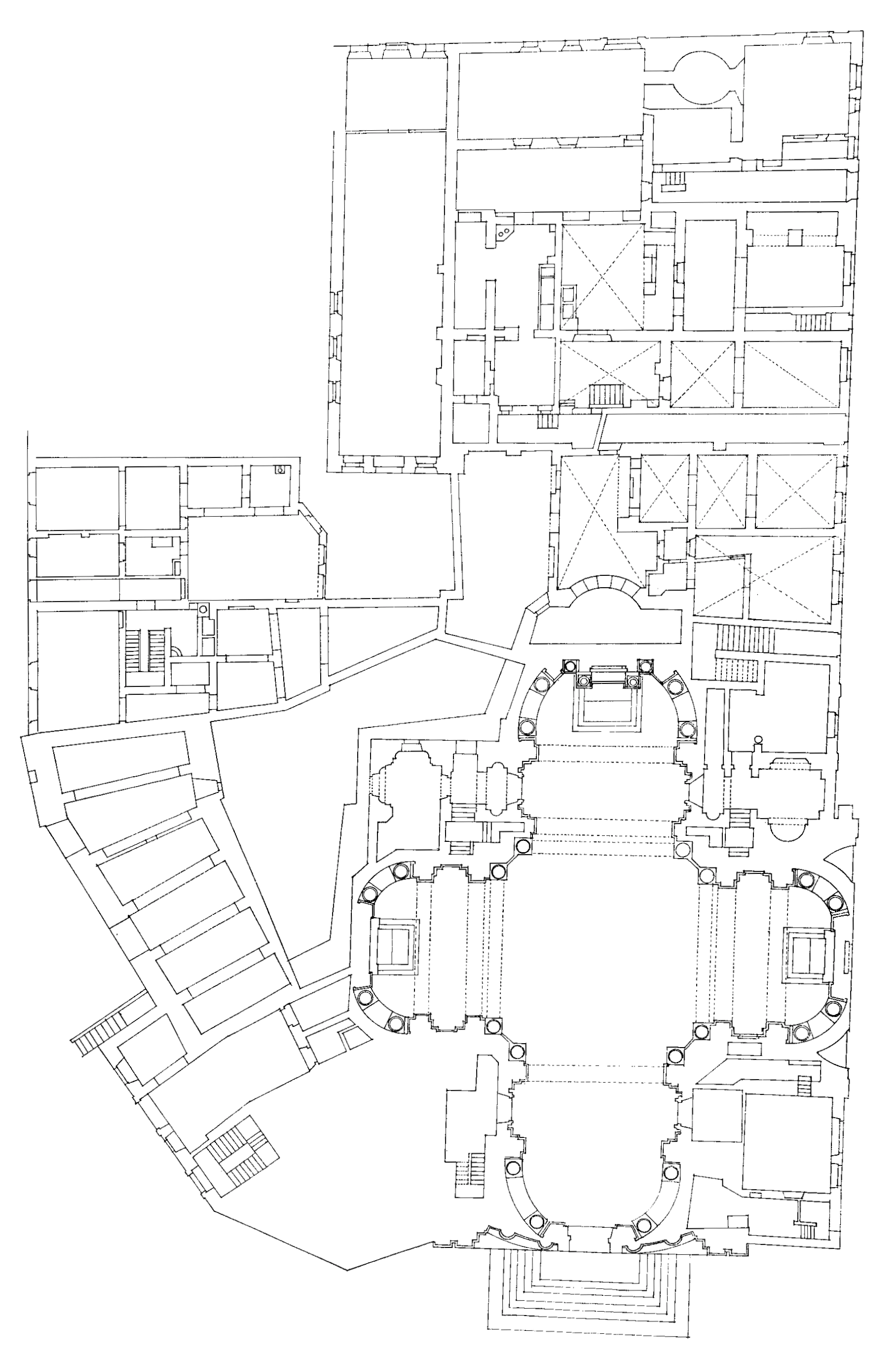

The interior is cross-shaped, with four arms meeting at a crossing with a dominating dome over it. The far and near ends match, and so do the two side arms, but the design of the latter is not the same as the former and the arms are slightly shorter.
The basic starting feature of the design is the set of four L-shaped dome piers. Each of these has a chamfered inner angle, two Ionic columns facing the crossing next to this and two outer pilasters in the same style towards the ends of the arms. These columns and pilasters support an entablature which runs around the entire interior, and from above the columns and pilasters spring double molded archivolts which define the large dome pendentives. These support in turn the dome cornice, the drum and the dome itself.
In each arm there follows a single bay. The sanctuary and entrance bays are much deeper than those in the side arms, but have similar design features as specified below. There are only two side chapels, one in each arm.
The recent restoration had the aim of returning the interior to its original colour scheme. It was found that Pietro da Cortona favoured a neutral creamy-limestone colour overall, but that Buratti in his 18th century restoration favoured a contrast between white detailing and a pale blue background. A compromise has been to keep the Buratti scheme for the vaults and pendentives, but to return to the original colour for the rest.
Entrance arm[]
The entrance arm matches the sanctuary arm pretty well. The single bay has a simple barrel vault, with a pair of triangular molded window lunettes. The windows that these contain are slightly curved at the top (echoing the curve of the façade) and each has a pair of little Doric pilasters supporting a split segmental pediment into which a post is inserted (the church is lit overall by super-entablature windows such as these).
The sides of the bay are each occupied by a bow-fronted balustraded cantoria (balcony for musicians) over a round-headed doorway. These appurtenances are by Buratti, not da Cortona.
The bay ends in an arch supported by a pair of tripletted Ionic pilasters. Beyond is the approximately semi-circular apse containing the entrance, with a conch or semi-dome. This is divided into three sectors by two broad ribs embellished with olive-leaf patterning, and each sector contains another window. However, these apse windows are much more ornate than the bay ones. Each has a pair of strap volutes supporting the split pediment, and instead of a post the latter contains a flaming urn device enclosed within a scallop shell. Above each of the three windows is an octagonal coffer containing a rosette, and above this is a crossed palm device.
Over the wooden interior doorcase is a tablet with a wreath and palm frond device, below a gabled cornice. Over this is another tablet commemorating the rebuilding of the church, which is dwarfed by an enormous straight entablature fragment which matches the actual curved entablature slightly behind on either side. The window above also lacks a curve. This design feature means that the apse is not actually semi-circular. On the entablature fragment is the heraldry of Pope Urban VIII, in relief and supported by a pair of putti. The apse side walls each have a pair of Ionic columns, and a square pillar flanking the entrance.
To the right of the entrance is the enjoyable and frothy late Baroque memorial to Carlo Pio Balestra 1786, in white marble with a lion peeping out from behind a creased parchment which bears the epitaph. A pair of putti holds up a medallion portrait. This work is signed by Tommaso Righi.
To the left is a memorial to Giovanna Garzoni 1670, much simpler and unfortunately with the portrait missing. She is noted in the epitaph as a famous miniaturist, but she is much better known nowadays for her still-life depictions of fruit. The little monument is by Mattia De Rossi.
Dome[]
The four pendentives bear stucco relief allegories of the four Evangelists. The designs were by Camillo Rusconi, but he died in 1728 before he could start work. Giuseppe Rusconi (his nephew) did St Matthew, St Mark was by Filippo della Valle and St Luke and St John were executed by Giovanni Battista Maini. The work was finished in 1730.
The dome drum rests on a full entablature, with modillions (little brackets) on the cornice. Above, the drum itself has eight almost square windows, separated by vaguely Doric pilasters flanked by blank rectangular panels. There are no proper pediments over the windows, but instead gables which are incorporated into a cornice from which the actual dome springs. This has eight ribs meeting at the lantern oculus which are embellished with olive-leaf ornament, and the sectors in between are coffered in large eight-pointed rosettes through which the ribs cut. The decoration is attributed to Ciro Ferri.
The floor below the oculus has an intricately formed circular iron grille, which lets some light into the crypt below.
Sanctuary[]
The design of the sanctuary copies that of the entrance arm, except that the apse is actually semi-circular as you can see from the curve of the entablature above the altar.
The altar aedicule is attributed to Ciro Ferri. It has a pair of alabaster Corinthian columns at the sides, supporting an entablature with a verde antico frieze and standing on tall plinths with red marble panels. A further pair of identical columns flank the altarpiece, which support a pair of strongly projecting posts in the entablature. These in turn support a triangular pediment with a verde antico tympanum, the central section of which is set back between the posts.
The altar frontal is in red, green and yellow marbles and is flanked by two shields of Pope Urban VIII. Above the altar is a rectangular niche framed in yellow marble, in which is a white marble statue of St Martina, which is by Nicola Menghini. The saint is shown reclining as if sleeping, and the work shows great technical skill.
Above this is the actual altarpiece, which is a copy by Antiveduto Grammatica of an original by Raphael in the possession of the Accademia. It shows St Luke at his easel, painting Our Lady holding a baby (and with Raphael himself in attendance). The original icon to which this legend belongs was the Hodegetria, which was venerated at the Panaghia Monastery at Constantinople until it was destroyed by the Turks. It has given rise to an enormous number of imitations, many of which have been claimed as original -including the Salus Populi Romani at Santa Maria Maggiore. A later twist to the legend describes the baby with whom Our Lady is posing as being the infant St Polycarp.
Chapel of St Lazarus[]
The right hand arm matches the left hand one. Compared to the entrance and sanctuary arms it appears "squashed". The bay is narrower, and the side windows are reduced to narrow blank triangular lunettes. The apse is not semi-circular, but the entablature of the conch approximates to three sides of a rectangle with curved corners. However, the interior of the conch matches those of the sanctuary and entrance.
The altar here is dedicated to St Lazarus Zographos, a 9th century monk of Constantinople who was a determined opponent of the iconoclast policy of the emperor Theophilus. As an artist he restored defaced icons, and as a result he was imprisoned and his hands burned to cripple them.
The altarpiece shows the saint undergoing the torture, and is by Lazzaro Baldi who also designed the aedicule. This consists of a pair of gigantic Ionic pilasters with swagged capitals, and revetting in red marble which has been thinly sliced to replicate the pattern in the stone. The pilasters reach up to the interior entablature, which is slightly brought forward above them and has its frieze in red marble in this portion. On top of the entablature are two angels with a tablet in black marble within a scallop which identifies the altar.
In the corners of the chapel are two matching monuments in polychrome marbles, provided by Baldi for himself and his sister. The two pairs of black marble putti are unusual.
Baldi finished his work here in 1682.
The plaster statue of a Franciscan in a posture of adoration looks like St Bernardine.
Chapel of the Assumption[]
The left hand arm contains an altar dedicated to the Assumption of Our Lady. The aedicule matches the one opposite, despite work on it only being completed in 1740 or fifty-eight years later. Sebastiano Conca was responsible for it, and painted the altarpiece which features St Sebastian (his patron). The angels sitting on the cornice are much more energetic than the ones over the other altar.
Memorials here are to Conca himself, a dignified tablet in a polychrome marble frame 1765, to Luigi Canina 1856 which has a white marble bust between two bas-reliefs depicting allegorical figures, and to Giovanni Cavalieri Nicolai 1857 with a frame identical to that of the Conca monument and a good marble medallion portrait.
Cappellette[]
The crypt or "lower church" is accessed by doorways to either side of the sanctuary bay. Each of these first leads down into a tiny chapel, the floor of which is extended through a side doorway as the upper landing of the main staircase down. Each of these cappellette has a funerary monument, the left hand one being that of Giovanni Battista Soria 1651 with a good bust, and the right hand one of Filippo Albacini who died in 1858 but whose memorial by Alberto Galli was unveiled in 1880.
These chapels are disused. The left hand one, which is used for access to the "lower church", has an altar with a frontal in bronze alabaster and green malachite and which recently (if not still) had three tabernacles stored on it, two seriously damaged. This chapel was apparently dedicated to St Gaudentius, the mythical Christian architect of the Colosseum. A 17th century forged epigraph, posing as ancient, which extolled him used to be in the church and is now in the lower church.
After a few steps, the stairs down turn at a right angle. In the angle of the turn of the left hand staircase is a bronze bust of Pietro da Cortona.
Lower church layout[]
The staircases end in two transverse corridors, the outer ends of which are blind. Opposite the bottoms of the staircases are two little altars in niches, again disused but with polychrome marble inlay frontals. The inner ends of these corridors emerge into a central octagonal room, right below the dome of the main church. From this in turn a corridor ending in a portal with an iron railing gate leads into a chapel containing the shrine of St Martina, which is under the sanctuary. This is in the shape of a cross with very broad, short arms. The near corners of the side arms of this have doorways leading into two further tiny chapels.
This "lower church" is at the same level as the ancient church, but there is no sign of any mediaeval fabric here now.
Octagon[]
The octagonal room has four statues of virgin martyrs in round-headed niches in the diagonal sides, framed by pairs of antique Doric columns in grey marble. SS Theodora, Sabina and Dorothea are by Cosimo Fancelli, and St Euphemia is by Pompeo Ferucci. They are helpfully labelled.
In the side facing the shrine-chapel is a little altar with a terracotta bas-relief of the Entombment of Christ by Alessandro Algardi. The altar itself encloses a relic-chest in alabaster.
The ceiling is a very shallow and low saucer dome with a central oculus containing the iron grating you saw in the floor under the dome above, and this is surrounded by a wide floral garland in white.
Three more pairs of the grey marble columns are a short distance down the three corridors leading off the octagon, the third being the one leading to the shrine-chapel.
Chapel of St Martina[]
In complete contrast to the upper church, the shrine chapel is embellished with rich and colourful polychrome marble and alabaster decoration including twelve Ionic columns in pavonazzetto marble. The white ceiling is a false saucer dome (actually flat), with radial coffering around the Dove of the Holy Spirit in glory.
The chapel has a magnificent free-standing gilt bronze altar embellished with lapis lazuli and sardonyx, designed by da Cortona and executed by Giovanni Canale Artusi. It contains the relics of SS Martina, Concordius and Epiphanius, and in honour of the virgin martyr the putti are playing with palm fronds and lilies (as on the church façade, symbols of martyrdom and virginity). The double-sided altarpiece is in the style of a cameo relief, showing St Martina having a vision of Our Lady, with the carved portions in alabaster. The depictions on the two sides are slightly different. The altar is surrounded by a low grey marble balustrade on three sides.
At the back of the chapel is a throne made of two slabs of grey-veined marble, allegedly from the mediaeval church but heavily restored when the church was rebuilt. It is described as the one in which the mediaeval pope sat in order to distribute candles at the beginning of the Candlemas procession.
The little left-hand side chapel contains a terracotta sculpture by Algardi featuring, apparently, SS Concordius and Epiphanius. Who is the third man? Nobody knows -his bones were found with the alleged three martyrs (including St Martina) when the rebuilding of the church began.
Side corridors[]
As well as a pair of grey marble columns near the octagon, already mentioned, the side corridors have another pair each at their ends, where there is a window.
The memorial that Pietro da Cortona provided for himself is in the far end of the right hand corridor. It has a good bust by Bernardo Fioriti, and a very long epitaph. Also in this corridor is the Gaudentius epitaph and a fragment of a pluteus (carved marble screen slab) from the mediaeval church.
Access[]
This church is open to visitors only on Saturdays, from 8:00 to 20:00.
It is not within the Roman Forum Archaeological Area.
Liturgy[]
After years of darkness, Mass is finally advertised as being regularly celebrated here.
According to the Diocese (June 2018), from October to April Mass is at 16:30 on Saturdays and the eves of solemnities, and from May it is at 18:00 ditto.
The feast-day of St Martina is 30 January.
External links[]
"De Alvariis" gallery on Flickr -exterior
"De Alvariis" gallery on Flickr - interior
"Marcantonioarchitects" blog page
Youtube slide-show by Canale di RomaItalyITA (good piano music)